
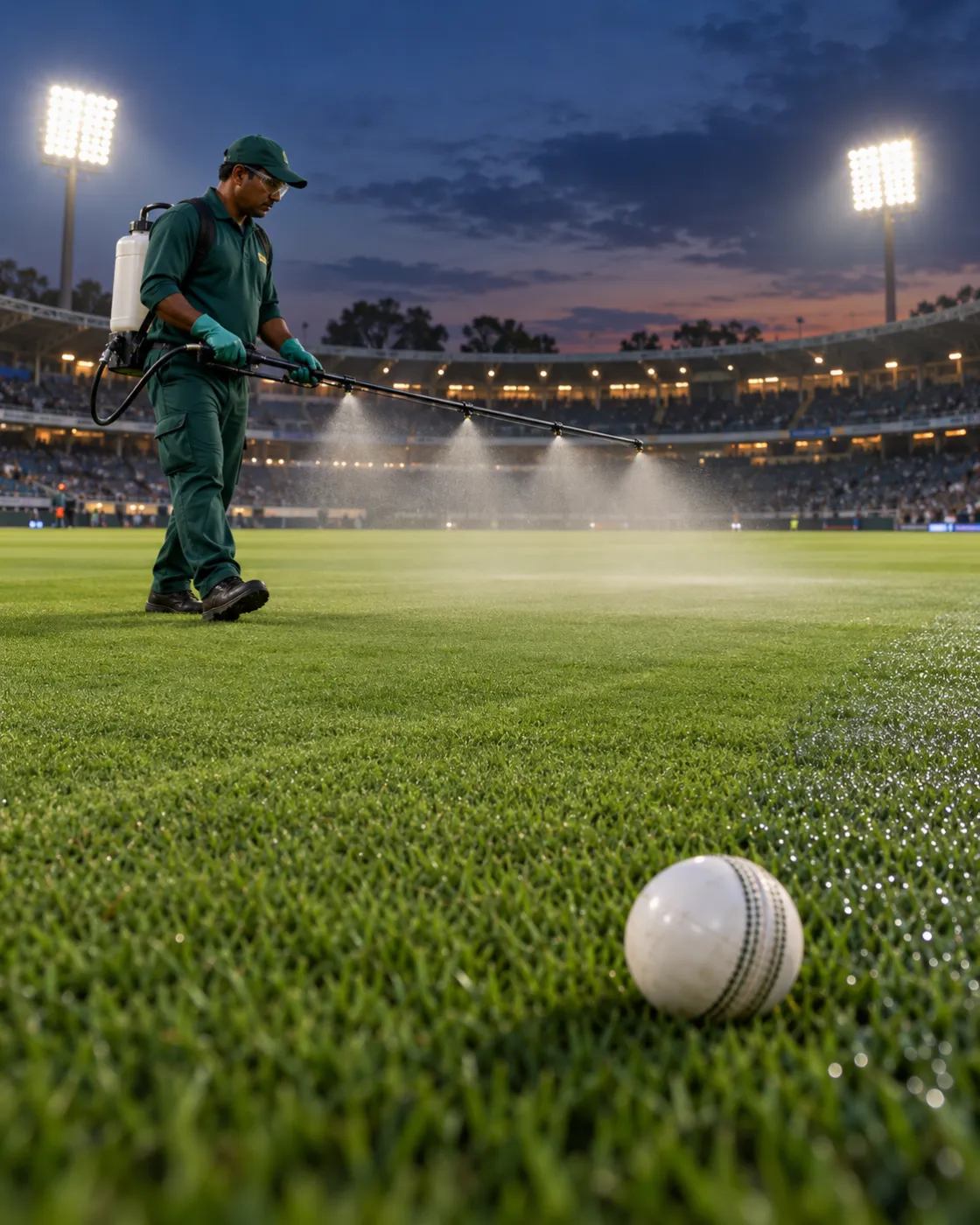
For a cricket curator, dew is not simply water on grass. When moisture settles on the outfield during a night match, it can wet the ball, change grip and handling, slow or alter the surface response, and make conditions different between the two innings.
Why evening dew matters in cricket
Dew forms when the turf canopy and surrounding air cool enough for water vapour to condense. The risk increases on clear, humid evenings with falling temperatures and limited air movement. The result can vary considerably across a venue because shade, grass density, irrigation history, soil moisture and air circulation are rarely uniform.
During a limited-overs night match, the operational concern is consistency. A wet ball can become harder for bowlers and fielders to control, while a damp outfield may influence pace and recovery. That is why dew forecasting and canopy-moisture management belong in the match-preparation plan—not as a last-minute reaction.
The practical goal is not to make turf unnaturally dry. It is to manage moisture on the leaf surface while protecting turf health, traction, appearance and the performance characteristics expected from the outfield.
What has been reported about DewCure
On 25 March 2026, The Times of India reported that DewCure was expected to be used during the IPL after use late in the preceding T20 World Cup, including at venues known for dew. The report described the product as a diluted liquid sprayed on the outfield to create a water-resistant barrier on grass blades while allowing moisture to move into the soil.
The newspaper further reported that the intention was to limit dew and guttation build-up, help keep the ball drier and reduce the degree to which evening moisture changes conditions between innings. These are claims reported by the publication; actual results at any venue depend on weather, turf species, canopy condition, application quality and the approved programme.
“Game-changer” chemical Dew Cure to debut in IPL — The Times of India, 25 March 2026 ↗
Where DewCure fits in a match-preparation programme
A dew-suppression treatment should be one part of a wider plan. Curators still need to assess forecast humidity, expected temperature drop, current leaf wetness, irrigation timing, mowing, canopy density, drainage and the operational window available before play.
Before considering treatment
- Record the areas where dew normally appears first and where it persists longest.
- Review the hourly forecast rather than relying only on the daily humidity figure.
- Check turf condition, recent inputs and irrigation history.
- Confirm sprayer calibration, water quality and the approved product directions.
- Plan a small, representative trial when using a programme at a venue for the first time.
After application
Observe leaf wetness across treated and untreated reference areas, turf response, surface traction and ball interaction under comparable evening conditions. A written venue record is more useful than relying on memory because weather can change sharply from one match to the next.
Questions curators commonly ask
Does dew suppression guarantee a completely dry outfield?
No. Results depend on the severity and duration of condensation, turf and weather conditions, application quality and the wider preparation programme. The realistic objective is improved moisture management and more consistent conditions.
Is dew the same as excess irrigation?
No. Dew is condensation on the surface, while irrigation adds water to the turf system. Soil moisture and irrigation timing can still influence canopy conditions and must be considered together.
Can the same programme be copied from another stadium?
A venue can learn from another site, but it should not copy a programme without assessment. Turf species, microclimate, water, equipment and match timing can all change the outcome.
Where can I find official product information?
See the DewCure product overview and technical-sheet link, then speak with Tirupathi Agro for guidance relevant to your outfield.